
Germany vs UK vs Malta for Nurses: Comparing the Study Routes
Germany vs UK vs Malta for nurses: compare Germany's nursing training, NMC-approved UK courses and Malta's bridging course, with language and visa basics.
Medcity Editorial Team
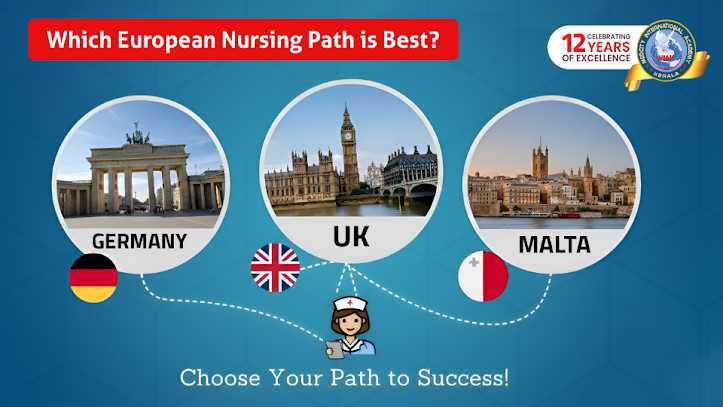
Quick answer
Germany, the UK and Malta offer nurses very different study routes. Germany's nursing Ausbildung lasts three years in German and needs B1 for the visa. In the UK, only NMC-approved programmes lead to registration. Malta requires non-EU nurses to complete a bridging course, with IELTS Academic 6 or OET equivalents and a verification certificate.
In this article
Comparing Germany vs UK vs Malta for nurses only makes sense once you look at what you would actually study in each country. The three routes are very different: Germany trains nurses through a three-year vocational programme taught in German, the UK registers nurses who complete an approved programme, and Malta expects nurses with non-EU qualifications to take a bridging course as part of registering. This guide compares them as study and training routes for students and nurses from Kerala, with the language and visa basics for each.
Three different kinds of route
Before comparing countries, be clear about where you are starting from.
- Not yet trained as a nurse: you are looking at a full nursing education abroad, such as Germany's nursing Ausbildung or a pre-registration degree in the UK.
- Already a BSc or GNM nurse: you are usually looking at further study, a recognition process or a bridging course, depending on the country.
The same country can mean a very different plan for these two groups, so read each section with your own starting point in mind.
Germany vs UK vs Malta for nurses at a glance
| Point | Germany | UK | Malta |
|---|---|---|---|
| Main study route | Nursing Ausbildung (Pflegefachfrau or Pflegefachmann), 3 years full-time | An NMC-approved nursing programme; other nursing degrees for further study | Non-EU nursing bridging course, required before registration |
| Language of daily life and training | German | English | English is widely used; check the language of your course with the provider |
| Language proof | B1 German, as a rule, for the training visa; at least B2 for recognition of a foreign nursing qualification | Degree-level student visa: English equivalent to CEFR B2 | Nursing council: IELTS Academic average of at least 6, or OET with B in speaking and at least C+ in the other parts |
| Money for the visa | Check the current figure on the official German pages | 1,529 pounds a month in London or 1,171 pounds a month elsewhere, for up to 9 months | At least 75 percent of Malta's national minimum wage for every month of study |
Sources are linked in each section below. Figures are as published in October 2026 and can change.
Germany: nursing training in German
Germany's generalist nursing training is regulated by the Nursing Professions Act. Under section 6 of the PflBG it lasts three years full-time, or at most five years part-time, and combines classroom teaching with practical training in hospitals and care settings, with practical training making up the larger share. The law also requires trainees to receive an appropriate training allowance (section 19).
The whole programme runs in German. Make it in Germany's page on the vocational training visa sets B1 as the usual language level for the visa, and nurses who already hold a qualification and want it recognised need at least B2, according to its nursing page. Germany suits students who are ready to spend a year or more on German before they travel and who are comfortable living and studying entirely in that language. Our Ausbildung in Germany page explains the training route in more detail.
UK: check that the course leads to registration
In the UK, the Nursing and Midwifery Council (NMC) approves the education programmes that lead to registration. Its approved programmes search lets you look up programmes by institution or course, and it warns that courses advertised elsewhere as "nursing diploma" courses are not NMC approved and will not lead to registration.
This matters for nurses from Kerala who plan a master's degree, because a nursing master's does not automatically lead to registration: some are approved pre-registration programmes, while others are designed for further study. If registration is your aim, confirm that the specific course appears in the NMC search as a pre-registration programme. If you mainly want a postgraduate qualification, a non-registration course can still be the right choice, as long as you know what it does and does not lead to.
For the student visa, the GOV.UK English rule is CEFR B2 for degree-level study, which your university can assess. You also need to show living costs of 1,529 pounds a month for courses in London or 1,171 pounds a month elsewhere, for up to nine months, held for at least 28 days in a row. See our study in the UK page for the application steps.
Malta: a bridging course before registration
Malta's Council for Nurses and Midwives sets out a specific path for nurses qualified outside the EU:
- You apply for temporary registration as a first-level nurse, granted for 24 months.
- Since 1 January 2025, you must include a Primary Source Verification certificate from a reputable company with your application.
- Registration is finalised only after a bridging course for non-EU nurses. MCAST, the University of Malta, IDEA Academy and APEX are among the providers the Council names.
- For English, the Council needs IELTS Academic with an average of at least 6, or OET with B in speaking and at least C+ in writing, reading and listening, valid when you apply.
The Council's list of nursing education institutions also shows that MCAST and the University of Malta offer pre-registration nursing programmes, which may interest students who have not yet trained.
If you come to Malta to study, the Central Visa Unit's checklist for a student national visa asks for an enrolment letter, proof of payment, bank statements showing funds of at least 75 percent of the national minimum wage for every month of study, and health insurance with at least 30,000 euros of medical cover. Identità's study FAQ adds that the study residence permit is for people accepted on a full-time higher education course (private primary and secondary schools also qualify) and that part-time courses are not eligible. Our study in Malta page has more on the country.
Which route suits you?
- Germany tends to fit students who will put in the time to reach B1 German or higher first, and who want a structured three-year training with a legally required allowance.
- The UK tends to fit students who want to study in English, provided the specific course leads to the outcome they want, NMC registration or a postgraduate qualification.
- Malta is mainly relevant for nurses who are already qualified, want an English-speaking setting and are prepared for the verification and bridging-course steps the Council sets.
We have not compared salaries or settlement options here, because this guide is about study routes and those figures change often. Whatever you choose, read the regulator's own page before paying any fee.
Next steps
German, IELTS and OET classes are offered by Medcity International Academy across Kerala. For help choosing a course in Germany, the UK or Malta and preparing your application, Medcity Overseas can guide you; reach us through our contact page.
Frequently asked questions
Can a nurse from India register in Malta?
Malta's Council for Nurses and Midwives offers temporary registration for 24 months to non-EU nurses. You need a Primary Source Verification certificate, the required English score, and you must attend a non-EU nursing bridging course before registration is completed.
Does a UK MSc in nursing make me an NMC registered nurse?
Only if it is an NMC-approved programme that leads to registration. Many master's courses are for further study. Check the course in the NMC's approved programmes search.
What German level do I need for nursing training in Germany?
B1 as a rule for the vocational training visa, according to Make it in Germany. Nurses seeking recognition of a foreign qualification need at least B2.
What English score does Malta ask nurses for?
IELTS Academic with an average of at least 6, or OET with B in speaking and at least C+ in writing, reading and listening, according to Malta's Council for Nurses and Midwives.
Official sources
Rules and requirements change. Check the latest details on these official websites.
Written by
Medcity Editorial Team
Medcity Overseas has guided students from Kerala to universities abroad since 2012. Rules on visas, fees and admissions change often: always check the official source linked in the article, or ask our counsellors before you apply.
Free counselling
Planning to study abroad? Talk to a Medcity counsellor.
Course, university, visa and funding guidance from our 18 branches across Kerala.